Dog Tapeworm Treatment When Returning to the UK: The 24–120 Hour Rule
If you're travelling abroad with your dog and returning to Great Britain, you probably need to arrange a tapeworm treatment before your journey home.
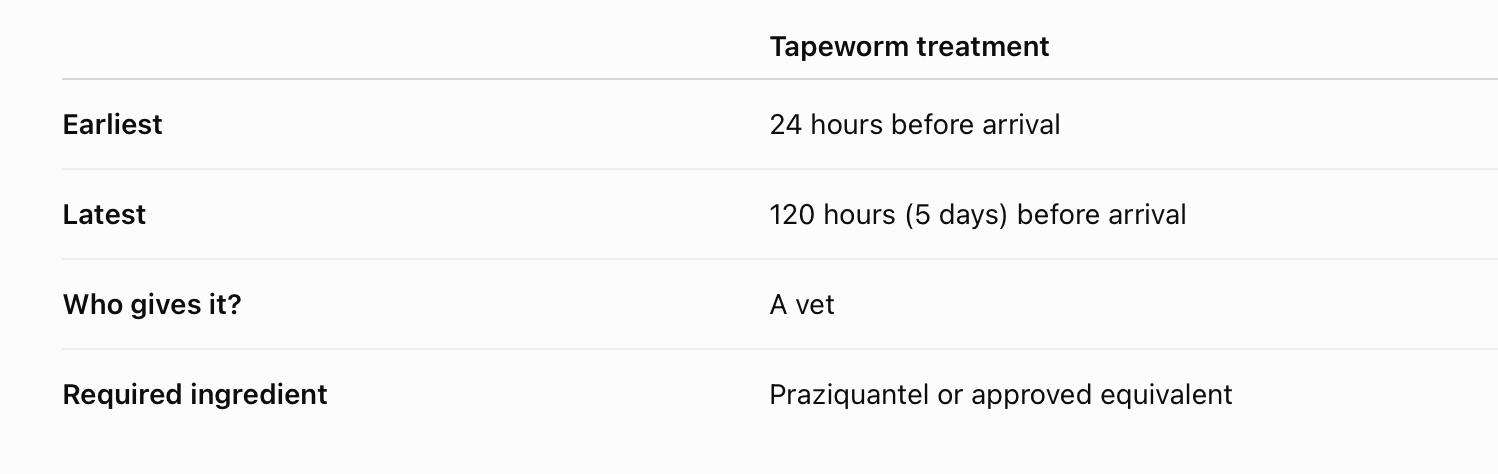
The timing is particularly important. Your dog must be treated by a vet no less than 24 hours and no more than 120 hours (5 days) before arriving in Great Britain.
If the treatment is given too early, too late, or isn't recorded correctly, your dog may not meet the UK pet travel requirements.
Here's what you need to know.
Does my dog need tapeworm treatment to return to the UK?
Most dogs travelling to Great Britain need a tapeworm treatment before entry.
⚠️ There are important exceptions. Your dog does not need tapeworm treatment if returning directly from:
Finland
Ireland
Malta
Northern Ireland
Norway
For dogs travelling from other countries, including most European countries, tapeworm treatment is required.
The requirement applies to dogs travelling with an Animal Health Certificate (AHC), pet passport or Great Britain pet health certificate.
Important: The rules apply to Great Britain — England, Scotland and Wales. Northern Ireland has a separate pet travel system.

When should my dog have the tapeworm treatment?
The treatment must be administered:
No less than 24 hours before your dog enters Great Britain
No more than 120 hours (5 days) before your dog enters Great Britain
And the 24-hour period is calculated from the exact time the treatment was administered, so the time recorded by the vet matters.
Example: If your dog is treated at 1pm on a Monday, you cannot enter Great Britain before 1pm on the Tuesday, and you must arrive before 1pm on the following Saturday.
⚠️ If your journey is delayed and you arrive more than 5 days after treatment, your dog will need to be treated again before you can travel.
Can I have the treatment done before leaving the UK?
Yes - if your trip is short enough.
For example, if you're travelling to France for a few days, you can have your dog treated by a vet in Great Britain before leaving, provided the treatment will still be within the required 24–120 hour window when you return.
What tapeworm treatment does my dog need?
The treatment must:
be authorised for use in the country where it is administered; and
contain praziquantel, or another treatment proven to be effective against Echinococcus multilocularis.
Your vet can advise which suitable product is available locally.
Who can administer the tapeworm treatment?
The treatment must be administered by a vet.
The vet does not have to be the same vet who issued your Animal Health Certificate, and APHA guidance confirms that the tapeworm treatment can be certified by any registered vet.
The treatment should be recorded in the relevant Echinococcus treatment section of the pet passport or health certificate.
Before leaving the veterinary practice, check that the information has been completed clearly and correctly (see below).
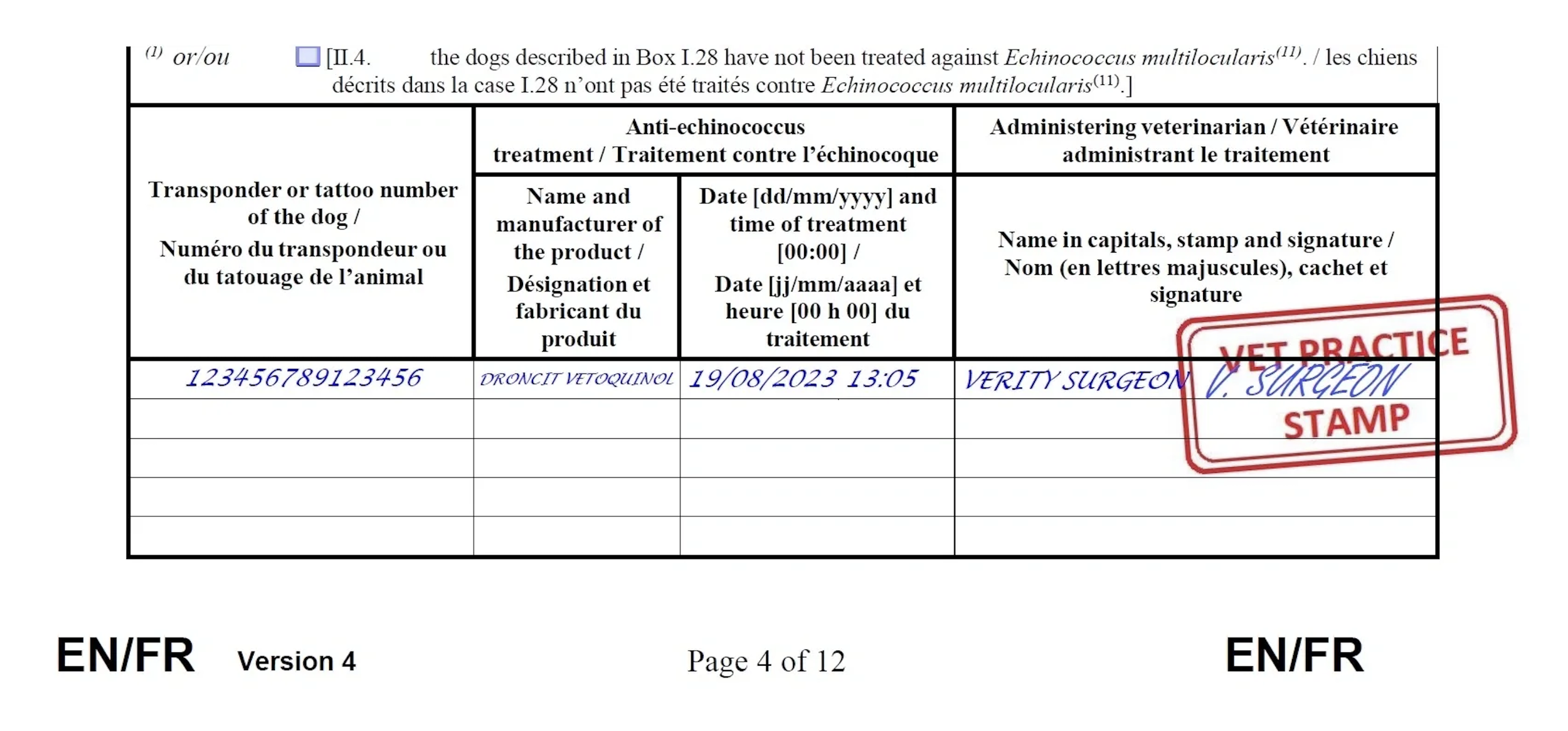
What does the vet need to record?
The treatment must be recorded in the appropriate section of your dog's pet travel document.
Your vet should record:
the product name and manufacturer
the date of treatment
the exact time of treatment
their stamp
their signature
Here is an example of the page correctly filled:
A Quick Checklist Before You Travel
✅ Confirm whether your route qualifies for the tapeworm exemption (Ireland, Northern Ireland, Finland, Norway, Malta).
✅ Book a vet appointment abroad for treatment within the 24–120 hour window before your scheduled arrival in Great Britain.
✅ Confirm the product used contains praziquantel or an approved equivalent.
✅ Check the vet has completed and signed the Echinococcus treatment section correctly (see the picture above).
✅ Keep your certificate accessible for inspection when you travel.
Need Help With an Animal Health Certificate?
Getting the paperwork and timing right for international pet travel can feel daunting, but it doesn't need to be stressful with the right guidance. If you're planning a trip and need an Animal Health Certificate, or you'd like advice on the tapeworm treatment requirements for your dog's return journey, get in touch and I'll be happy to help make sure everything is in order before you travel.
-
The treatment must be given at least 24 hours and no more than 120 hours (5 days) before your dog enters Great Britain.
-
Yes. France is not one of the countries exempt from the Great Britain tapeworm treatment requirement.
-
Yes. Spain is not one of the exempt countries, so your dog will need the treatment before entering Great Britain.
-
Yes, if your trip is short enough for the treatment to remain within the 24–120-hour window when you return.
-
Your dog won’t meet the Great Britain pet travel requirements. If you are affected by a delay or another problem with the treatment timing, speak to your carrier and a vet as soon as possible.
-
No, provided your dog is travelling directly from the Republic of Ireland to Great Britain. Ireland is one of the exempt countries.